

- Close



02/04/2026 |
Knowledge Snapshot: Webinar „Navigating Knowledge Careers in a new Geopolitics”
Article by:
Share Article


Hosted and organized by Mark Pelling, Max Hope, Alexander Fekete, Abigail Ewen, Rajani Prajapati
Introduction
The second session of the Tomorrow’s Cities Community of Practice Webinar Series, organized by TCIN (Tomorrow’s Cities Innovation Network) and RISK-KAN, explored knowledge careers in an evolving geopolitical landscape. Bringing together early career researchers, academics, and practitioners, the webinar examined career pathways, interdisciplinary collaboration, and the growing connections between research, policy, and practice.
Speaker Spotlight
Dr Chenbo Wang, Capturing Human Dependencies on the Built Environment for Enriched Natural Hazard Risk Assessments
Chris Hetkämper, Personas of system-relevant critical infrastructure actors – roles, responsibilities and effects of disruption
Dr Mark Ojal, Rethinking the city in a multi-hazard resilience context
Panelists
Abigail Ewen: Evidence and Advocacy Officer – Inclusive Resilience, CMB Global
Alexander Fekete: Professor for Risk and Crisis Management, TH Köln – University of Applied Sciences Cologne
Gemma Gremen Associate Professor for Risk and Resilience Engineering, University College London
Mark Ojal: Urban Mobility and Disaster Resilience Specialist, UN-Habitat Kenya
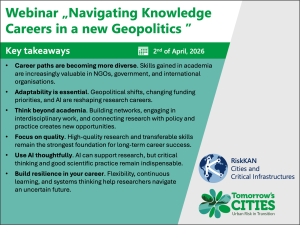
Key Takeaways
- Career paths are becoming more diverse. Skills gained in academia are increasingly valuable in NGOs, government, and international organisations.
- Adaptability is essential. Geopolitical shifts, changing funding priorities, and AI are reshaping research careers.
- Think beyond academia. Building networks, engaging in interdisciplinary work, and connecting research with policy and practice creates new opportunities.
- Focus on quality. High-quality research and transferable skills remain the strongest foundation for long-term career success.
- Use AI thoughtfully. AI can support research, but critical thinking and good scientific practice remain indispensable.
- Build resilience in your career. Flexibility, continuous learning, and systems thinking help researchers navigate an uncertain future.
Share Article
More Stories