

- Close



15/05/2026 |
Knowledge Snapshot: Webinar “Tomorrow’s Cities: Co-designing urban futures for equitable resilience”
Article by:
Share Article


Hosted and organized by Mark Pelling, Max Hope, Alexander Fekete, Chris Hetkämper, Rajani Prajapati
Introduction
The third session of the Tomorrow’s Cities Community of Practice Webinar Series, organized by TCIN (Tomorrow’s Cities Innovation Network) and RISK-KAN, celebrated the launch of the special issue Tomorrow’s Cities: Co-designing Urban Futures for Equitable Resilience. The webinar brought together researchers, practitioners, and policymakers to share experiences with co-creative approaches and discuss how collaborative urban planning can strengthen equitable resilience.
Speaker Spotlight
Ali Abdelhamid
The future of Ghaza: existing plans can frame a locally inclusive and risk-sensitive reconstruction
Abdelhamid, A.; Pelling, M.; Basdogan, S.; Chanin-Morris, R.; Comelli, T.; Dabbeek, J.; Mentese, E.
Mark Pelling, Max Hope
Critical learning: a pathway towards transformative action for urban resilience
Deshpande, T.; Pelling, M.; Ojal, M.; Hope, M.
Jeremy Philips
Moving into danger? Embedding hazard modelling in a participatory workshop to support risk-sensitive urban development in Quito, Ecuador
Philips J.; Cruz, B; Menoscal, J; Vasconez, FJ; Zapata, C; Cupuerán, MI; Johnson, K; Andrade, D; Córdova, M and Sevilla, E.
Harry Smith, Soledad Garcia-Ferrari
From protesting to proposing: the evolution of community organizations’ involvement in co-managing disaster risk management in Comuna 8, Medellín, Colombia
Smith, H.; Garcia-Ferrari, S.; Castaneda, C.; Mera, W.; Garcia, A.; Cartagena, R.
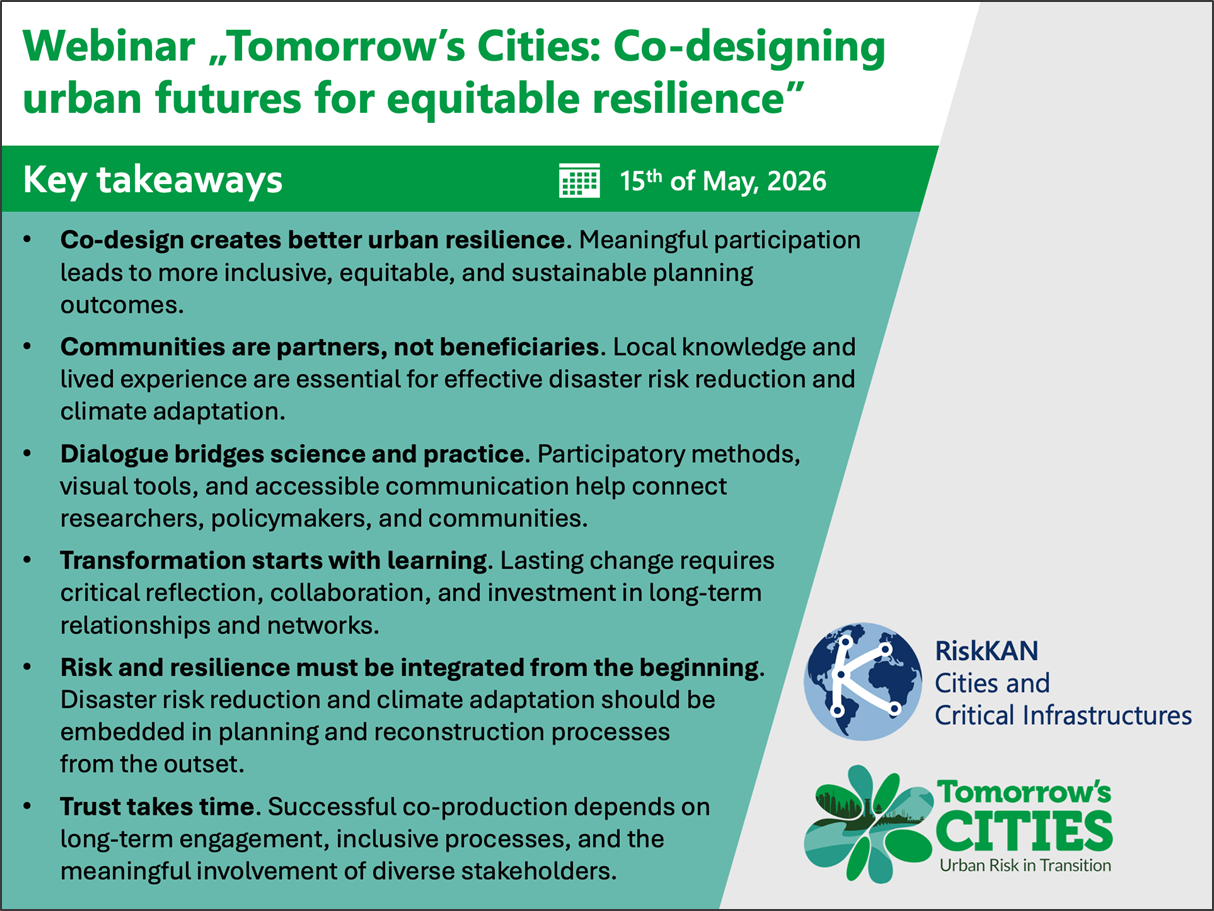
Key Takeaways
Ali Abdelhamid
The future of Ghaza: existing plans can frame a locally inclusive and risk-sensitive reconstruction
Abdelhamid, A.; Pelling, M.; Basdogan, S.; Chanin-Morris, R.; Comelli, T.; Dabbeek, J.; Mentese, E.
- Fast reconstruction without participation risks creating long-term problems and reproducing inequalities.
- The Turkish Antakya model offers a hybrid, participatory approach that could inform Gaza’s reconstruction.
- Climate adaption and disaster risk reduction must be integrated from the outset of any reconstruction process.
Mark Pelling, Max Hope
Critical learning: a pathway towards transformative action for urban resilience
Deshpande, T.; Pelling, M.; Ojal, M.; Hope, M.
- Transformative learning requires triple-loop reflection that questions fundamental values, not just policy delivery.
- The Tomorrow’s Cities methodology demonstrated that scientific communities can also change their behavior through participatory processes.
- Translating personal transformative learning into system-level change requires deliberate investment in networks, pathways, and public spaces for dialogue.
Highlights of the first Q & A session:
Engaging diverse actor groups requires intentional design, long-term investment, and a genuine commitment to including marginalized voices.
GIS mapping of community visions was found to be a powerful tool for bridging community and policymaker languages.
Jeremy Philips
Moving into danger? Embedding hazard modelling in a participatory workshop to support risk-sensitive urban development in Quito, Ecuador
Philips J.; Cruz, B; Menoscal, J; Vasconez, FJ; Zapata, C; Cupuerán, MI; Johnson, K; Andrade, D; Córdova, M and Sevilla, E.
- Simplified, participatory hazard modeling can serve as an effective tool for building dialogue and shared understanding between technical experts and municipal actors.
- The participatory setting is essential for discussing model uncertainties and limitations openly.
- The approach can be expanded to include communities directly, building dialogue between communities, risk managers, and urban planners.
Harry Smith, Soledad Garcia-Ferrari
From protesting to proposing: the evolution of community organizations’ involvement in co-managing disaster risk management in Comuna 8, Medellín, Colombia
Smith, H.; Garcia-Ferrari, S.; Castaneda, C.; Mera, W.; Garcia, A.; Cartagena, R.
- Long-term, community-led engagement is essential for building the trust and knowledge needed for effective disaster risk management and climate adaptation.
- Communities are not homogenous and should not be underestimated in their capacity to engage with and translate scientific knowledge.
- The link between disaster risk management and climate adaptation must be integrated, and this integration is most effective when driven by communities themselves.
Highlights of the second Q & A session:
Scientific language and tools can be enablers rather than barriers when sufficient time and participatory design are invested.
Communities motivated by lived experience of risk are often highly capable of engaging with and translating scientific knowledge.
Progressive knowledge-building: starting from community visions and lived experience before introducing technical tools, is an effective approach.
Share Article
More Stories