

- Close


25/02/2026 |
Knowledge Snapshot: Webinar “Urban Risk Research and Practice”
Article by:
Share Article


Hosted and organized by Mark Pelling, Max Hope, Abigail Ewen, Alexander Fekete, Dilli Paudel, Basir Zisan, Jonathan Menoscal, Rajani Prajapati, Prayash Malla
Introduction
The first session of the Tomorrow’s Cities Community of Practice Webinar Series, organized by TCIN (Tomorrow’s Cities Innovation Network) and RISK-KAN, explored the challenges and opportunities of advancing multi-hazard, risk-informed planning. Bringing together city representatives and international partners, the webinar focused on how projects can effectively influence policy and practice despite evolving internal and external conditions.
Speaker Spotlight
Dr Abigail Ewen is a researcher at UCL whose work explores disability inclusion in disaster resilience and recovery. Drawing on research in post-earthquake Nepal, she highlights how disaster response can either advance or hinder the meaningful participation and rights of people with disabilities in risk reduction and resilience-building.
Key Takeaways
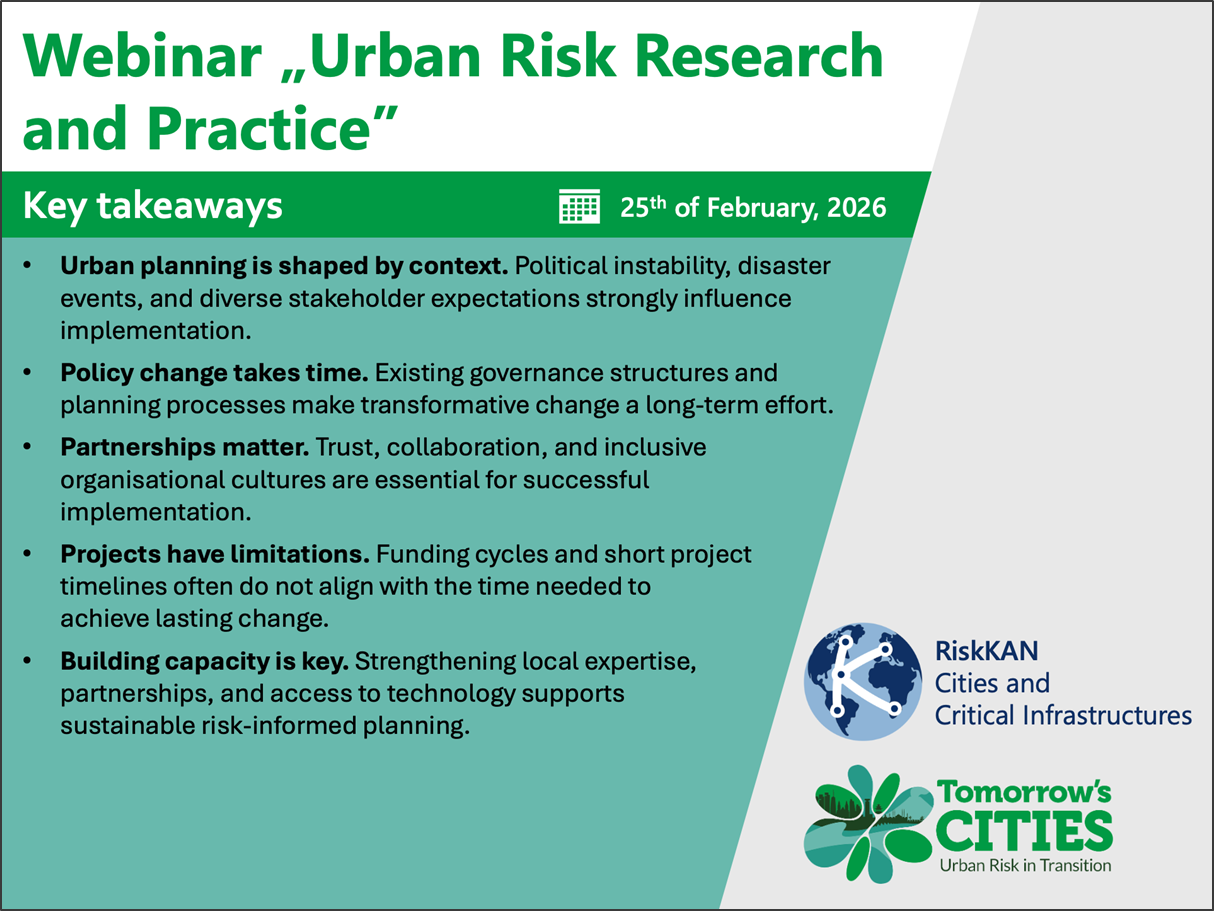
Barriers for cities in implementing risk-informed, multi-hazard urban planning policies and practices
- Contextual Barriers: Desire for action, disaster events, stakeholder needs and expectations, political instability. (optional) Quotes from the webinar
- Policy Barriers: Change in policy, governance structure, processes of planning, existing policy processes.
- Organizational Barriers: Relationships with partners, existing processes, trust, working processes, gender representation, behavior change.
- Project Barriers: Reporting timescales, funding deadlines, project timeline.
- Capacity Barriers: academics, local partners, technology.
Identified challenges
Change often evolves over a longer time period than most research projects can cover;
Policy change is challenging because every city and stakeholder constellation has unique needs and contextual conditions;
Political shifts and personnel changes can affect the long-term impact and sustainability of project outcomes.
Share Article
More Stories